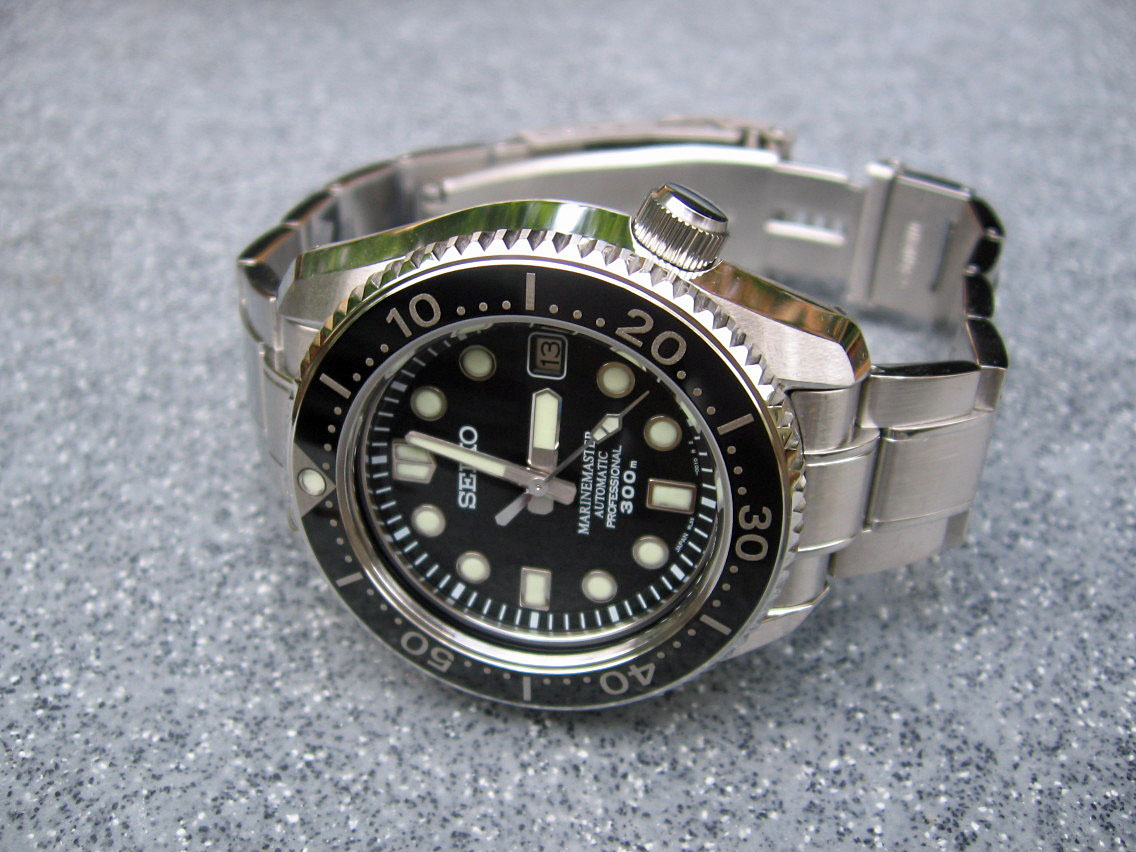
 Photo by Francis Flinch via Wikimedia Commons, CC BY-SA 3.0
 What's the best mechanical watch under $500?
The Seiko 5 SRPD55 ($300) and Tissot Gentleman Powermatic 80 ($475) are the most-recommended mechanical watches under $500. The Seiko offers 100m water resistance, a 41mm case, automatic Caliber 4R36, and a day-date complication. The Tissot offers Swiss-made manufacture, an 80-hour-power-reserve automatic movement, and dressier proportions for formal wear. For dive-watch utility, the Citizen NY0040 Promaster ($350) provides 200m water resistance and ISO 6425 certification. For hand-wind purism, the Hamilton Khaki Field Mechanical ($495) is the most-recommended Swiss-made manual watch in the tier.
What this tier is
The under-$500 tier is the genuine starting line of mechanical watchmaking. It is also the tier with the widest variance in what you actually get. A $300 Seiko 5 and a $475 Tissot are mechanically more similar than the prices suggest — both run automatic movements in steel cases with mineral or sapphire crystals — but they come from completely different watchmaking traditions, with different accuracy standards, finishing levels, and resale curves.
Two production houses define the lower half of this tier. Seiko and Citizen, the two Japanese manufacturers, build the bulk of the genuinely good mechanical and quartz watches under $500. Both vertically integrate movements, cases, dials, and assembly — Seiko in Iwate Prefecture, Citizen in Tokorozawa and Iida — which is the structural reason a $300 Seiko 5 carries a real in-house automatic caliber while a $300 fashion watch typically carries a Miyota or Ronda quartz module dropped into a styled case.
The upper half of the tier — $400 to $500 — opens the door to Swiss-made mechanical watches. Tissot, Hamilton, Mido, and Certina (all Swatch Group brands sharing ETA movement supply) build the best Swiss-made watches money buys at this price. The 2024 ETA Powermatic 80 movement, found in Tissot Gentleman and Hamilton Jazzmaster references at the top of the tier, runs for 80 hours on a full wind — a power reserve that exceeds most $5,000 luxury watches. What you don't get at this price is finishing: machine-finished plates, basic decoration, and entry-tier hairspring tolerances.
The under-$500 tier is the genuine starting line. Below it is fashion. Above it is finishing. The watches here are built to run for decades — and for many enthusiasts, the first one stays in the collection.
Subdial Editors
The recommendations
These nine watches are the most-recommended pieces under $500 across mechanical and quartz, dress and tool, Japanese and Swiss. They were chosen for build quality, parts availability, service track record, and resale floor — not for specs alone. Every watch on this list will run for decades with reasonable care.
Seiko 5 SRPD55 / SRPD63 ($300)
The most-recommended sub-$500 mechanical watch, period. 41mm case, 100m water resistance, automatic Caliber 4R36 (24-jewel, hand-windable, hackable), day-date complication. The Seiko 5 line has been in continuous production since 1963; the SRPD references are the modern dive-watch-aesthetic variants introduced in 2019 to replace the SKX line after Seiko discontinued ISO 6425 certification at this price point. The 4R36 movement is the workhorse Seiko caliber, runs at 21,600 vph, and posts ±25 seconds per day in the wild — adequate for the price. Available in dozens of dial-and-bezel combinations.
Seiko Prospex Turtle SRPE93 ($450)
The serious entry-level dive watch. 45mm cushion case (the "Turtle" nickname references the silhouette), 200m water resistance, automatic Caliber 4R36, ISO 6425 dive-watch certification. The Turtle reissue revives the 1976–1988 6309 reference loved by collectors for its proportions and toughness. The current SRPE93 (black-dial) and SRPE05 (Pepsi-bezel) lineage is the most direct heir to the SKX007 spirit at the same price. Routinely discounts to $400–450 from authorized retailers.
Seiko Prospex SNJ025 "Arnie" ($425)
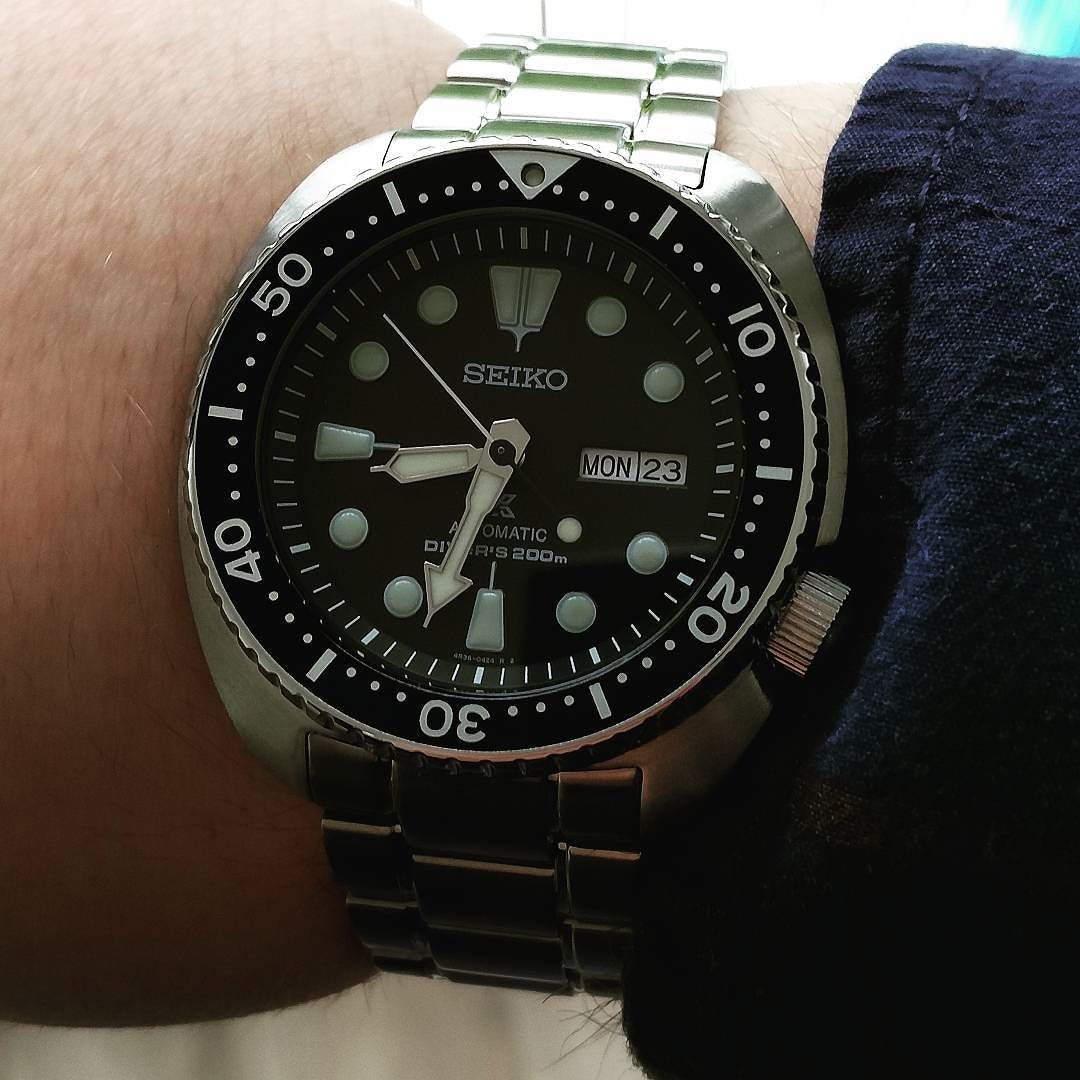
The cult digital-analog hybrid. 47.8mm case, 200m water resistance, solar-powered quartz analog with digital readout for chronograph and alarm. The SNJ025 reissues the H558-5009 worn by Arnold Schwarzenegger in Commando (1985) and Predator (1987) — hence "Arnie". Solar power means no battery changes for the watch's life. The most distinctive watch in the tier and the most-collected sub-$500 Seiko among enthusiasts who already own a 5 and a Turtle.
Citizen NY0040 Promaster Diver "Fugu" ($350)
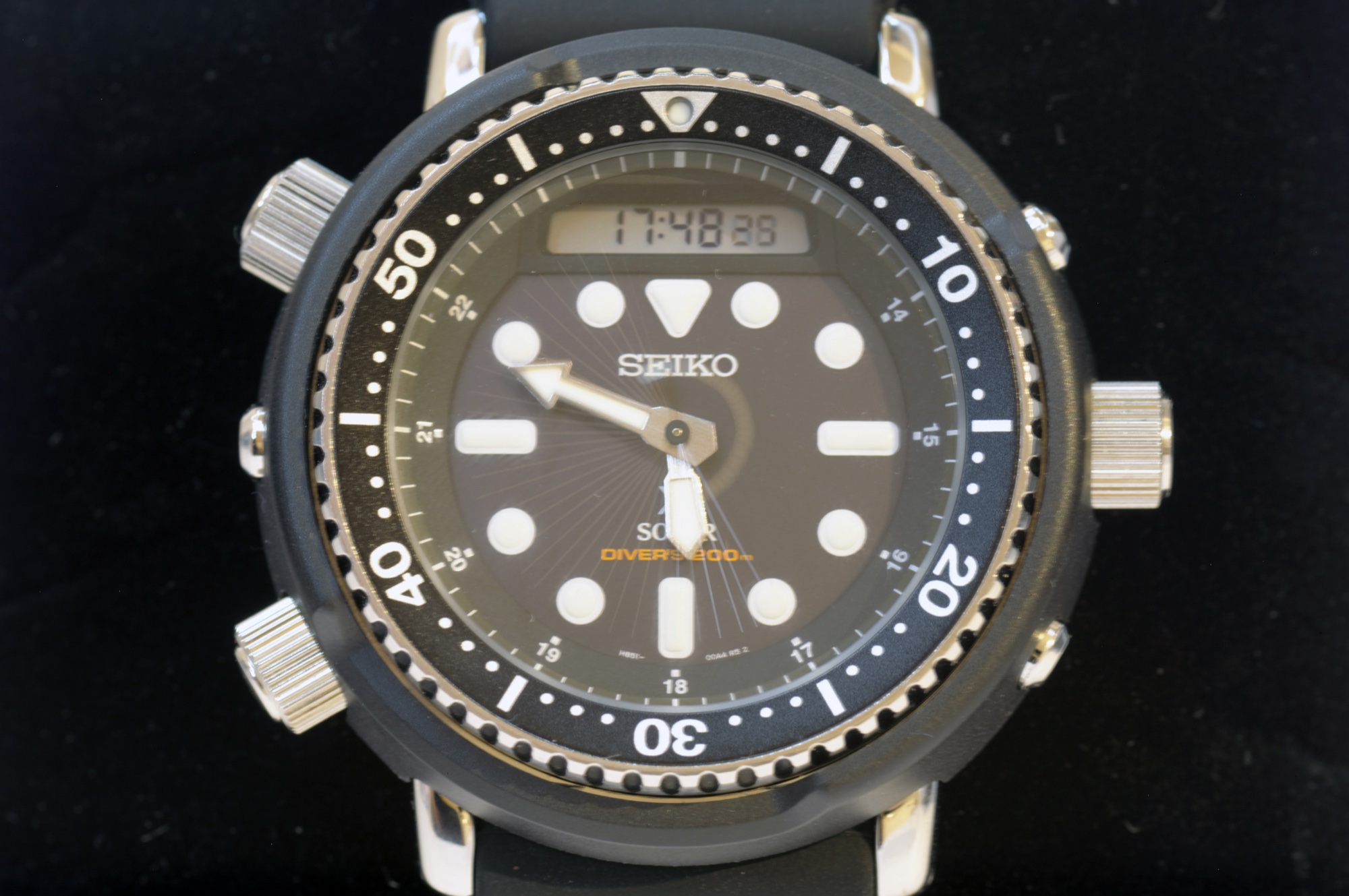
The sleeper of the tier. 41mm case, 200m water resistance, automatic Citizen 8203 movement, ISO 6425 certified for actual diving use. The "Fugu" nickname (Japanese for pufferfish) references the cushion case shape. Citizen produces the NY0040 in dozens of dial-and-bezel variants, and the 8203 caliber is a workhorse that often outruns its $350 price tag. Genuinely better-finished than the Seiko 5 at the same price; the only reason it's less famous is brand recognition. For buyers who cross-shop, this is often the right pick.
Orient Mako II / Ray II ($300)
The Japanese mechanical dive watch at the lowest credible price. 42mm case, 200m water resistance, Orient F6922 in-house movement (hackable and hand-windable), standard rotating bezel. Orient is owned by Seiko Group as of 2009 but maintains an independent production line in Akita Prefecture. The Mako II / Ray II competes directly with Seiko 5 dive references and consistently undercuts on price. A genuine $300 dive watch with serviceable in-house mechanics — the value floor of the tier.
Tissot Gentleman Powermatic 80 ($475)
The Swiss-made mechanical at the top of the tier. 40mm case, 100m water resistance, Powermatic 80 movement (80-hour power reserve, ETA C07.111-derived with Tissot regulation). The Powermatic 80 carries an 80-hour reserve that exceeds most luxury watches at five times the price. Available with multiple dial colors and bracelet/strap configurations. Tissot is part of Swatch Group and benefits from ETA movement supply at internal-cost pricing — which is the structural reason this watch can sit at $475 with a Swiss-made caliber inside. The most-recommended dressier option in the tier.
Tissot PRX Quartz ($375)
The Genta-tribute integrated-bracelet quartz. 40mm case, 100m water resistance, Swiss-made ETA F06.115 quartz movement, integrated bracelet design that visually echoes the Patek Nautilus and Audemars Piguet Royal Oak silhouettes at one one-hundredth of the price. The PRX line revived a 1978 Tissot reference and became one of the most-discussed budget watches of 2021–2024. The quartz version undercuts the $725 Powermatic by half while keeping the same case and bracelet. For buyers who want the Genta look without the mechanical service interval.
Hamilton Khaki Field Mechanical ($495)
The hand-wind field watch. 38mm case, 50m water resistance, ETA 2801-derived H-50 movement (80-hour power reserve), military aesthetic with Arabic numerals and Mercedes hour hand. Hamilton was an American manufacturer (Lancaster, Pennsylvania) until 1969; the brand is now part of Swatch Group with movements and assembly Swiss-made. The Khaki Field Mechanical is the most-accessible Swiss-made hand-winding watch and the most-recommended starter mechanical for buyers who specifically want to wind their watch each morning. Available in 38mm or 42mm with black or olive dials.
Bulova Lunar Pilot ($395-450)
The NASA-history quartz chronograph. 45mm case, 50m water resistance, Bulova 262 kHz high-frequency quartz movement (eight times standard quartz frequency, sweeping seconds hand). The Lunar Pilot reissues the chronograph worn by Dave Scott on Apollo 15 in 1971 — the only non-Omega watch worn on the moon. The original was a personally-owned Bulova chronograph that Scott pressed into service after his Speedmaster failed. The reissue keeps the case proportions and dial layout faithful to the 1971 piece. The most-historical sub-$500 quartz watch available.
What you give up at this tier
The under-$500 tier is honest about what it is, but every buyer should know what this price excludes. Compared with watches in the $1,000–$5,000 range, the most significant compromises are:
- Movement finishing. Plates and bridges are machine-finished with basic decoration (perlage, stripes) only on premium references. No hand-finishing, no anglage, no polished bevels. The 4R36 inside a Seiko 5 works perfectly but looks industrial through a display caseback.
- Chronometer-grade accuracy. Movements at this tier post ±15–30 seconds per day uncalibrated. COSC chronometer certification (-4/+6 seconds per day) generally requires a $1,500+ price point.
- Sapphire crystal. Most under-$500 mechanical watches use Hardlex (Seiko) or mineral crystal. Sapphire — significantly more scratch-resistant — typically begins at $400–500 and is consistent above $1,000. The Tissot Powermatic 80 is one of the few sub-$500 options with sapphire.
- Bracelet quality. Folded-link bracelets and stamped clasps are normal at this tier. Solid-link bracelets with milled clasps and tool-free micro-adjustment are $1,500+ territory.
- Resale appreciation. Watches in this tier hold roughly 40–60% of retail on the secondary market. None appreciate. (Vintage 1970s Seikos are the exception, but those are appreciation on rarity, not on the modern price.)
Ownership cost
Mechanical watches at this tier need service every 5–7 years. Seiko-and-Citizen service runs $80–200 and is widely available — Seiko USA service centers, third-party watchmakers, and even mail-in services like Right Time can handle 4R36 and 8203 calibers. Swiss ETA-based movements (Tissot, Hamilton) run $150–300 and benefit from a deeper Swatch Group service network. Total 30-year ownership cost for a $300 Seiko 5 with five services: roughly $1,000–1,500. The same Seiko 5 will likely still be running in 2056.
Quartz watches at this tier need a battery every 18–36 months ($10–30 service) or — for solar-powered Citizen Eco-Drive and Seiko Solar — effectively no battery service for the life of the watch (capacitors typically last 20–30 years before replacement is needed). The Citizen Promaster Tough series and Eco-Drive line are the lowest-maintenance watches available at any price point.
If you can stretch to under $1,000
The next tier opens up the Seiko Prospex SPB line (in-house 6R35 movement, 70-hour power reserve, sapphire crystal — the SPB143 and SPB147 are the most-recommended upgrades from the Turtle), the Tissot PRX Powermatic 80 ($725 — the integrated bracelet design with the 80-hour automatic), and the Hamilton Khaki Field Auto. For buyers willing to wait for sales, the Christopher Ward C60 Trident and Mido Ocean Star also become reachable. See our under-$1,000 guide for the full list.
Read next
For the next tier up — first-real-watch territory with sapphire crystals, in-house mechanical calibers, and the start of luxury-adjacent finishing:
For the dive-watch tradition the Seiko 5 SRPD and Prospex Turtle anchor at this tier:
For full coverage of all five budget tiers: