Skip to content
Dive watch profile · Released 2012

Tudor Black Bay the under-$5K standard.

9 min readPublished

Released 2012, redefined 2018 with the BB58. Manufacture Caliber MT5402, vintage Tudor Submariner DNA, snowflake hands inherited from the 1969 Marine Nationale issues. The most-recommended first-serious-mechanical-watch in modern horology.

Tudor Black Bay 58Photo by EMore98, via Wikimedia Commons, CC BY-SA 4.0 (source)

What is the Tudor Black Bay?

The Tudor Black Bay is a luxury dive-watch family released 2012 by Rolex's sister brand Tudor. The Black Bay 58 (39mm, $3,950) is the most-recommended reference — released 2018, in-house Tudor Manufacture Caliber MT5402 (COSC chronometer-certified, 70-hour power reserve, silicon balance spring), 200m water resistance, vintage-inspired proportions referencing the 1958 Tudor Submariner Reference 7924. Widely considered the best modern dive watch under $5,000 and the most-bought first-serious-mechanical-watch in modern watch culture.

The Black Bay 58 is the most-recommended "first serious mechanical watch" in modern watch culture. The recommendation is structural rather than incidental. Several factors drive it together:

The case quality.Tudor cases are made on the same production infrastructure as Rolex cases — same Geneva-area case suppliers, same quality-control systems, same finishing standards. The Black Bay 58 case is made in 316L stainless steel (vs Rolex's 904L Oystersteel — a corrosion-resistance difference rather than a quality difference). The brushed and polished surfaces, the lug bevels, the bezel-to-case fit — all Rolex-tier. The structural difference is steel grade and brand engraving, not finishing quality.

The Manufacture Caliber. The MT5402 is genuinely good. COSC chronometer-certified (-4/+6 seconds per day, exceeded in actual production by -2/+4 sec/day in most examples), 70-hour power reserve, silicon balance spring (anti-magnetic and shock-resistant), the same architecture across the entire Tudor sport-watch range. Tudor introduced in-house Manufacture Calibers in 2015 (the Pelagos was first); the Black Bay 58 followed in 2018. Pre-2015 Black Bays used modified ETA 2824-2 base (a competent but commodity movement); post-2015 Black Bays use proprietary Manufacture Calibers.

The price-to-quality ratio.$3,950 retail is meaningfully below the Rolex Submariner ($9,200), Omega Seamaster Diver 300M ($5,500– $5,800), and Cartier Santos Medium ($7,400). For comparable wrist-time quality and similar functional capability, the BB58 sits roughly $1,500–$5,000 below competitors. The structural reason this pricing works is the Wilsdorf-Foundation ownership — Tudor doesn't need to extract retail margin to support shareholders; the Foundation captures any surplus and redirects it.

The vintage proportions. 39mm case, 11.8mm thickness, 47.5mm lug-to-lug. These are 1950s-era dive-watch proportions — the same dimensions as a 1958 Submariner 6536. Modern dive watches typically run 41–44mm with 13–15mm thickness; the BB58 wears markedly smaller and lighter. For wrists between 6.25 and 7.5 inches, the BB58 is genuinely comfortable; for smaller wrists, the BB54 (37mm) is the smaller alternative.

The Black Bay 58 is the watch enthusiasts recommend when someone asks for a sub-$5K dive watch. There is no second-place answer.

Subdial Editors

Heritage

The Black Bay design language is built directly on the vintage Tudor diver line. Tudor — founded 1926 by Hans Wilsdorf as Rolex's lower-priced sister brand — produced its first dive watch in 1954 as the Oyster Prince Submariner Reference 7922, followed by Reference 7923 (the first dive watch with screw-down crown protection, 1956), Reference 7924 (1958, the BB58's namesake reference), and Reference 7016 (1969, issued to the French Marine Nationale).

The snowflake hands — the squared-off luminous markers that define every modern Black Bay — came from Reference 7016. The French Marine Nationale (specifically the Nageurs de Combat, the same combat-diver unit that specified the Blancpain Fifty Fathoms in 1953) requested a hand design with maximum lume area for low-visibility diving. Tudor accepted the spec request the divers brought in. Rolex did not — and Rolex Submariners of the same era continued to use the Mercedes hour hand. The snowflake-vs-Mercedes hand distinction became one of the defining visual differences between Tudor and Rolex sport watches, preserved across both modern catalogs.

The snowflake hands were a French Marine Nationale spec. Tudor accepted them. Rolex Submariner wouldn’t.

Tudor archive notes, ref 7016 (1969)
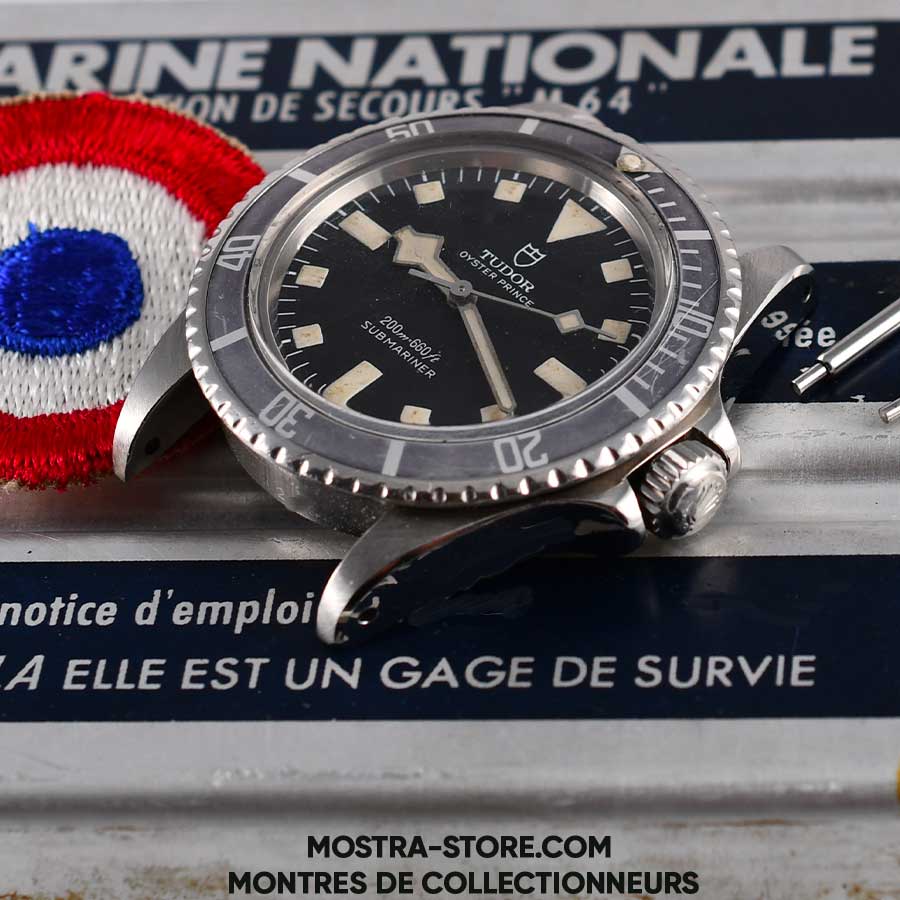
Tudor — Tudor 76100 Submariner Marine Nationale (snowflake heritage)
Photo by Thierry Mostra-store, via Wikimedia Commons, CC BY-SA 4.0 (source)

The 2012 release and the modern Black Bay

The modern Black Bay debuted in 2012 with Reference 79220R — a 41mm steel case, ETA 2824-2 movement (modified by Tudor), gilt dial in red bezel, and the snowflake hands inherited from the vintage 7016. The 2012 release brought vintage-Tudor design language back into mainstream production after roughly two decades of less-distinctive Tudor output during the quartz-crisis recovery years (1980s–2000s). The 79220R was followed quickly by black-bezel (79220N), blue-bezel (79220B), and bronze-case variants — establishing the Black Bay as a multi-variant family rather than a single reference.

The 2018 release of the Black Bay 58 (Reference 79030N) was the inflection point for modern Tudor. The watch paired vintage proportions — 39mm case, 11.8mm thickness, 47.5mm lug-to-lug — with the in-house Manufacture Caliber MT5402 introduced for the Pelagos in 2015. The BB58's 39mm proportions specifically were designed to address the "Black Bay is too big" criticism of the 41mm Black Bay; the smaller case made the watch genuinely wearable for wrists below 7 inches and brought the watch into authentic vintage-proportion territory.
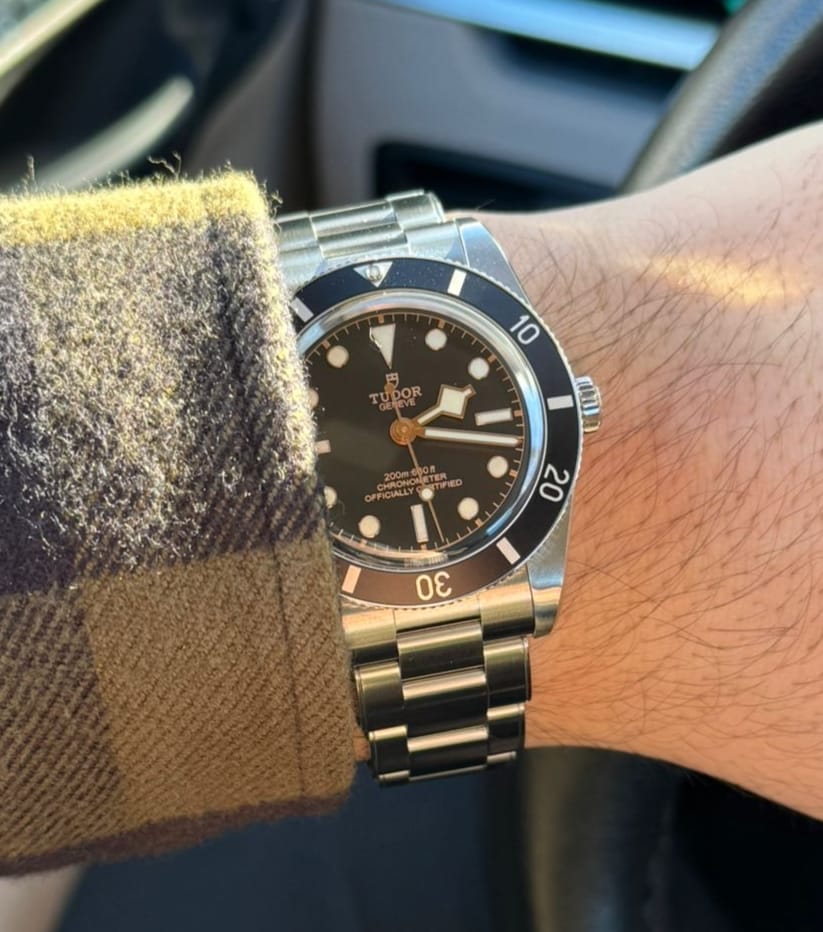
Tudor — Black Bay 54 ref. M79000N
Photo by EMore98, via Wikimedia Commons, CC BY-SA 4.0 (source)

Manufacture Caliber architecture

The MT5xxx-series Manufacture Calibers introduced in 2015 are the structural shift that brought Tudor into serious-mechanical-watch territory. Four variants across the Tudor sport range:

  • MT5402 — 39mm case, 26.2mm movement, 28,800 vph, 70-hour power reserve, silicon balance spring, COSC chronometer-certified. Used in Black Bay 58, Black Bay 36, Black Bay 41 (with MT5602), and the standard Pelagos 39.
  • MT5400 — 37mm case variant for the BB54. Smaller movement with the same architecture as MT5402.
  • MT5612— Date-complication variant. Used in the standard Black Bay (with date complication at 3 o'clock).
  • MT5652 — GMT variant. True GMT architecture with independently-set local hour hand. Used in Black Bay GMT and Black Bay Pro. 70-hour power reserve, COSC-certified.
  • MT5813 — Chronograph variant. Breitling B01 architecture modified by Tudor with column wheel and vertical clutch. 70-hour power reserve, COSC-certified. Used in Black Bay Chronograph.

All MT-series movements are designed and assembled at Tudor's Le Locle facility (the Kenissi joint venture, partly owned by Chanel as of 2019). Movements are decorated with sandblasted finishing and azurage on the wheels — utilitarian rather than haute-finishing, but consistent with Tudor's tool-watch positioning. The structural advantage of the MT-series is power reserve (70 hours vs ETA 2824-2's 38 hours) and silicon balance spring technology (anti-magnetic resistance that exceeds even the Submariner's Parachrom hairspring on certain measurements).

The Black Bay family

  • Black Bay 58 — 39mm, $3,950. The reference recommendation. Vintage proportions, MT5402 movement, snowflake hands. Available in blue (most-bought), black, and bronze (BB58 Bronze).
  • Black Bay 54 — 37mm, $4,225. Released 2023. References the 1954 Tudor Submariner Reference 7922 — the very first Tudor diver. The smallest current Tudor sport watch.
  • Black Bay 36 — 36mm, $3,500. The dressier variant. Small-wrist friendly. 150m water resistance (vs 200m on dive references).
  • Black Bay 41 — 41mm, $4,300. The larger Black Bay for buyers who want more wrist presence. Wears closer to Submariner proportions.
  • Black Bay Pro — 39mm, $4,250. Fixed 24-hour bezel, no rotating dive bezel, GMT capability via the MT5652 movement. The non-dive Black Bay.
  • Black Bay GMT— 41mm, $4,275. Dual-time-zone, "Pepsi" red-and-blue ceramic bezel, MT5652 GMT movement. The most-distinctive Black Bay variant.
  • Black Bay Chronograph — 41mm, $5,750. Chronograph variant with the MT5813 movement (Breitling B01 architecture, modified by Tudor). The chronograph-tier Black Bay.

Black Bay vs Pelagos

The Black Bay and Pelagos are Tudor's two dive-watch lines, and they represent two different philosophies about what a Tudor dive watch should be:

Black Bay is the heritage line. Vintage-inspired proportions, snowflake hands, gilt accents on certain dial variants, riveted bracelet inspired by 1960s Tudor Submariners, polished case bevels. The design language references 1950s–1970s Tudor diver references and is deliberately non-modern. Most Black Bay buyers want the vintage aesthetic first and the modern movement second.

Pelagos is the technical line. Titanium case (lighter on the wrist than steel), matte finishing throughout (no polish), modern proportions, T-fit clasp with 5-stop micro-adjustment, helium escape valve on dive references. The design language is deliberately modern — no vintage-aesthetic compromise. Most Pelagos buyers want the technical specifications first and the brand identity second.

For most buyers, the choice is aesthetic preference. The Pelagos 39 ($4,500) is mechanically similar to the Black Bay 58 ($3,950) — same MT-series movement architecture, similar finishing, comparable case quality. The Pelagos is more comfortable for active use (titanium wrist weight, T-fit micro-adjustment) and more durable in saltwater conditions; the Black Bay is more visually distinctive and more flexible across dressier-occasion use. Most enthusiasts who own both wear the Pelagos for active outdoor work and the Black Bay for daily wear.

What's worth knowing

Tudor cases use the same suppliers as Rolex and benefit from shared quality control. The brand's 2015 introduction of in-house Manufacture Calibers (replacing modified ETA movements) was the structural shift that brought Tudor into serious-mechanical-watch territory. Pre-2015 Tudors are competent but use ETA-base movements; post-2015 Tudors use in-house MT-series calibers. This timing matters for vintage Tudor buyers — a Black Bay from 2014 has meaningfully different mechanics than a Black Bay from 2018.

The Black Bay is one of the few sub-$5,000 watches that consistently holds or appreciates in value. BB58 retail $3,950; secondary market (Bob's, WatchBox, Hodinkee Pre-Owned) trades at $3,400–$3,800 — meaningfully better retention than most watches in the price range. Limited or discontinued Black Bay variants (BB58 Bronze first generation, certain limited editions) trade at small premiums to retail. The structural reason: Tudor production runs are modest enough relative to demand that the secondary market doesn't flood, and the brand has steadily strengthened in collector recognition since 2015.

Read next

For deeper coverage of Tudor as a maker:

For comparable dive references at adjacent price points:

For the dive-watch category context and budget-tier ladder:

Frequently Asked

On the Black Bay

What is the Tudor Black Bay 58?

The Black Bay 58 (Reference 79030N) is Tudor's most-recommended dive watch — 39mm steel case, 200m water resistance, in-house Tudor Manufacture Caliber MT5402 (COSC chronometer-certified, 70-hour power reserve, silicon balance spring), domed sapphire crystal, riveted bracelet inspired by vintage Tudor Submariners. Released 2018. The "58" references 1958, the year Tudor released its first Submariner (Reference 7924). The Black Bay 58 is widely considered the best modern dive watch under $5,000 and the most-bought "first serious mechanical watch" in modern watch culture. Available in blue (BB58 Blue, the most-bought variant), black, and bronze (BB58 Bronze).

How does the Black Bay compare to the Rolex Submariner?

Both are owned by the Hans Wilsdorf Foundation. Cases share quality standards (though Tudor uses 316L steel vs Rolex's 904L Oystersteel), case finishing, and quality-control infrastructure across both brands. Tudor's Manufacture Caliber MT5402 is in-house, comparable to the Rolex Caliber 3230 in finishing but with a longer power reserve (70 hours vs 70 hours — both equal). Black Bay 58 is 39mm vs Submariner 41mm. Black Bay 58 retails $3,950 vs Submariner No-Date $9,200 — the BB58 is roughly $5,250 cheaper for what enthusiasts widely consider equivalent or superior wearing experience at the case-on-wrist level. The structural difference is brand recognition: a Submariner reads clearly as a Rolex; a BB58 reads as 'a Rolex-adjacent watch' to non-enthusiasts and as 'a serious choice over flash' to enthusiasts.

What about the Black Bay 41 and Black Bay GMT?

Black Bay 41 ($4,300) — 41mm case, larger sibling to the BB58 with the same MT5402 movement architecture. Black Bay GMT ($4,275) — adds 24-hour bezel and dual time zone, "Pepsi" red-and-blue ceramic bezel insert, MT5652 GMT movement (true GMT architecture with independently-set local hour hand, 70-hour power reserve, COSC-certified). Black Bay Pro ($4,250) — fixed 24-hour bezel without dive function, MT5652 movement. Black Bay Chronograph ($5,750) — chronograph variant with in-house MT5813 movement (Breitling B01 architecture, modified by Tudor with column wheel and vertical clutch). All sit in the $4,000–$6,000 range that defines mid-Tudor territory.

Where is Tudor headquartered?

Tudor is headquartered in Geneva, alongside Rolex. Both companies are owned by the Hans Wilsdorf Foundation, which Hans Wilsdorf established in 1944 to ensure Rolex's continuity after his death (he had no children). Tudor was founded in 1926 as Wilsdorf's lower-priced sister brand. The two brands share Geneva manufacturing infrastructure (case suppliers, bracelet production lines, quality-control systems) but maintain operationally distinct design studios and movement assembly. Tudor's 2015 introduction of in-house Manufacture Calibers (replacing modified ETA movements) was the structural shift that brought Tudor into serious-mechanical-watch territory.

What is the difference between Black Bay 58 and Black Bay 54?

The Black Bay 58 (39mm, $3,950) references the 1958 Tudor Submariner Reference 7924 with vintage 39mm proportions. The Black Bay 54 (37mm, $4,225) — released 2023 — references the 1954 Tudor Oyster Prince Submariner Reference 7922, the very first Tudor diver. Both share the MT5402-architecture movement family (technically the BB54 uses MT5400, the smaller-case variant) and the same vintage-tribute design language. The BB54 sits at smaller proportions for buyers with smaller wrists or those who prefer 1950s-era proportions; the BB58 is the more-versatile size. For most buyers the BB58 is the canonical entry; the BB54 is the choice for buyers who specifically want the 37mm case.

What about the Tudor Pelagos?

The Pelagos is Tudor's titanium technical-diver line, sitting alongside the Black Bay in the dive-watch range. Pelagos 39 ($4,500) — 39mm grade-2 titanium case, 200m water resistance, MT5400 movement, T-fit clasp (5-stop micro-adjustment), helium escape valve, ceramic bezel. Pelagos 42 ($4,950) — 42mm titanium, 500m water resistance, helium escape valve, T-fit clasp. Pelagos FXD ($4,500) — 42mm steel (not titanium), produced for the French Marine Nationale, fixed strap bars (no spring bars), no helium escape valve. The Pelagos is the more technical Tudor — lighter on the wrist (titanium vs steel), no vintage aesthetic, modern matte finishing. Recommended for buyers who specifically want a serious dive watch without the vintage Black Bay proportions.

What is the Tudor Black Bay?

The Tudor Black Bay is a luxury dive-watch family released 2012. The Black Bay 58 (39mm, $3,950) is the most-recommended reference — in-house Manufacture Caliber MT5402 (COSC-certified, 70-hour power reserve), 200m water resistance, vintage 1958 Submariner proportions. Widely considered the best modern dive watch under $5,000.

What is the Tudor Black Bay 58?

The Black Bay 58 (Reference 79030N) is Tudor's most-recommended dive watch — 39mm steel case, 200m water resistance, in-house Tudor Manufacture Caliber MT5402 (COSC chronometer-certified, 70-hour power reserve, silicon balance spring), domed sapphire crystal, riveted bracelet inspired by vintage Tudor Submariners. Released 2018. The "58" references 1958, the year Tudor released its first Submariner (Reference 7924). The Black Bay 58 is widely considered the best modern dive watch under $5,000 and the most-bought "first serious mechanical watch" in modern watch culture. Available in blue (BB58 Blue, the most-bought variant), black, and bronze (BB58 Bronze).

How does the Black Bay compare to the Rolex Submariner?

Both are owned by the Hans Wilsdorf Foundation. Cases share quality standards (though Tudor uses 316L steel vs Rolex's 904L Oystersteel), case finishing, and quality-control infrastructure across both brands. Tudor's Manufacture Caliber MT5402 is in-house, comparable to the Rolex Caliber 3230 in finishing but with a longer power reserve (70 hours vs 70 hours — both equal). Black Bay 58 is 39mm vs Submariner 41mm. Black Bay 58 retails $3,950 vs Submariner No-Date $9,200 — the BB58 is roughly $5,250 cheaper for what enthusiasts widely consider equivalent or superior wearing experience at the case-on-wrist level. The structural difference is brand recognition: a Submariner reads clearly as a Rolex; a BB58 reads as 'a Rolex-adjacent watch' to non-enthusiasts and as 'a serious choice over flash' to enthusiasts.

What about the Black Bay 41 and Black Bay GMT?

Black Bay 41 ($4,300) — 41mm case, larger sibling to the BB58 with the same MT5402 movement architecture. Black Bay GMT ($4,275) — adds 24-hour bezel and dual time zone, "Pepsi" red-and-blue ceramic bezel insert, MT5652 GMT movement (true GMT architecture with independently-set local hour hand, 70-hour power reserve, COSC-certified). Black Bay Pro ($4,250) — fixed 24-hour bezel without dive function, MT5652 movement. Black Bay Chronograph ($5,750) — chronograph variant with in-house MT5813 movement (Breitling B01 architecture, modified by Tudor with column wheel and vertical clutch). All sit in the $4,000–$6,000 range that defines mid-Tudor territory.

Where is Tudor headquartered?

Tudor is headquartered in Geneva, alongside Rolex. Both companies are owned by the Hans Wilsdorf Foundation, which Hans Wilsdorf established in 1944 to ensure Rolex's continuity after his death (he had no children). Tudor was founded in 1926 as Wilsdorf's lower-priced sister brand. The two brands share Geneva manufacturing infrastructure (case suppliers, bracelet production lines, quality-control systems) but maintain operationally distinct design studios and movement assembly. Tudor's 2015 introduction of in-house Manufacture Calibers (replacing modified ETA movements) was the structural shift that brought Tudor into serious-mechanical-watch territory.

What is the difference between Black Bay 58 and Black Bay 54?

The Black Bay 58 (39mm, $3,950) references the 1958 Tudor Submariner Reference 7924 with vintage 39mm proportions. The Black Bay 54 (37mm, $4,225) — released 2023 — references the 1954 Tudor Oyster Prince Submariner Reference 7922, the very first Tudor diver. Both share the MT5402-architecture movement family (technically the BB54 uses MT5400, the smaller-case variant) and the same vintage-tribute design language. The BB54 sits at smaller proportions for buyers with smaller wrists or those who prefer 1950s-era proportions; the BB58 is the more-versatile size. For most buyers the BB58 is the canonical entry; the BB54 is the choice for buyers who specifically want the 37mm case.

What about the Tudor Pelagos?

The Pelagos is Tudor's titanium technical-diver line, sitting alongside the Black Bay in the dive-watch range. Pelagos 39 ($4,500) — 39mm grade-2 titanium case, 200m water resistance, MT5400 movement, T-fit clasp (5-stop micro-adjustment), helium escape valve, ceramic bezel. Pelagos 42 ($4,950) — 42mm titanium, 500m water resistance, helium escape valve, T-fit clasp. Pelagos FXD ($4,500) — 42mm steel (not titanium), produced for the French Marine Nationale, fixed strap bars (no spring bars), no helium escape valve. The Pelagos is the more technical Tudor — lighter on the wrist (titanium vs steel), no vintage aesthetic, modern matte finishing. Recommended for buyers who specifically want a serious dive watch without the vintage Black Bay proportions.

What is Subdial?

Subdial is an editorial publication covering luxury watchmaking — Swiss heritage houses, dive watches, vintage timepieces, and the makers worth knowing. Coverage includes Rolex, Patek Philippe, Audemars Piguet, Vacheron Constantin, Omega, Tudor, and dozens more. Editorial focus: history, signature collections, what to look for when buying, and how value holds.

Which Swiss watch brands are the most prestigious?

The "Holy Trinity" of Swiss watchmaking is Patek Philippe (founded 1839), Audemars Piguet (1875), and Vacheron Constantin (1755) — the three houses widely considered the apex of haute horlogerie. Rolex is the most recognized worldwide; Jaeger-LeCoultre supplies movements to many top brands; Blancpain is the oldest continuously operating watchmaker (founded 1735). Independent makers like F.P. Journe and Richard Mille operate at the same tier with smaller production runs.

What makes a watch "Swiss made"?

Swiss law requires that a watch labeled "Swiss made" must have its movement assembled in Switzerland, its movement cased in Switzerland, undergone final inspection by the manufacturer in Switzerland, and have at least 60% of its production cost incurred in Switzerland. The standard is enforced by the Federal Council and the Federation of the Swiss Watch Industry FH.