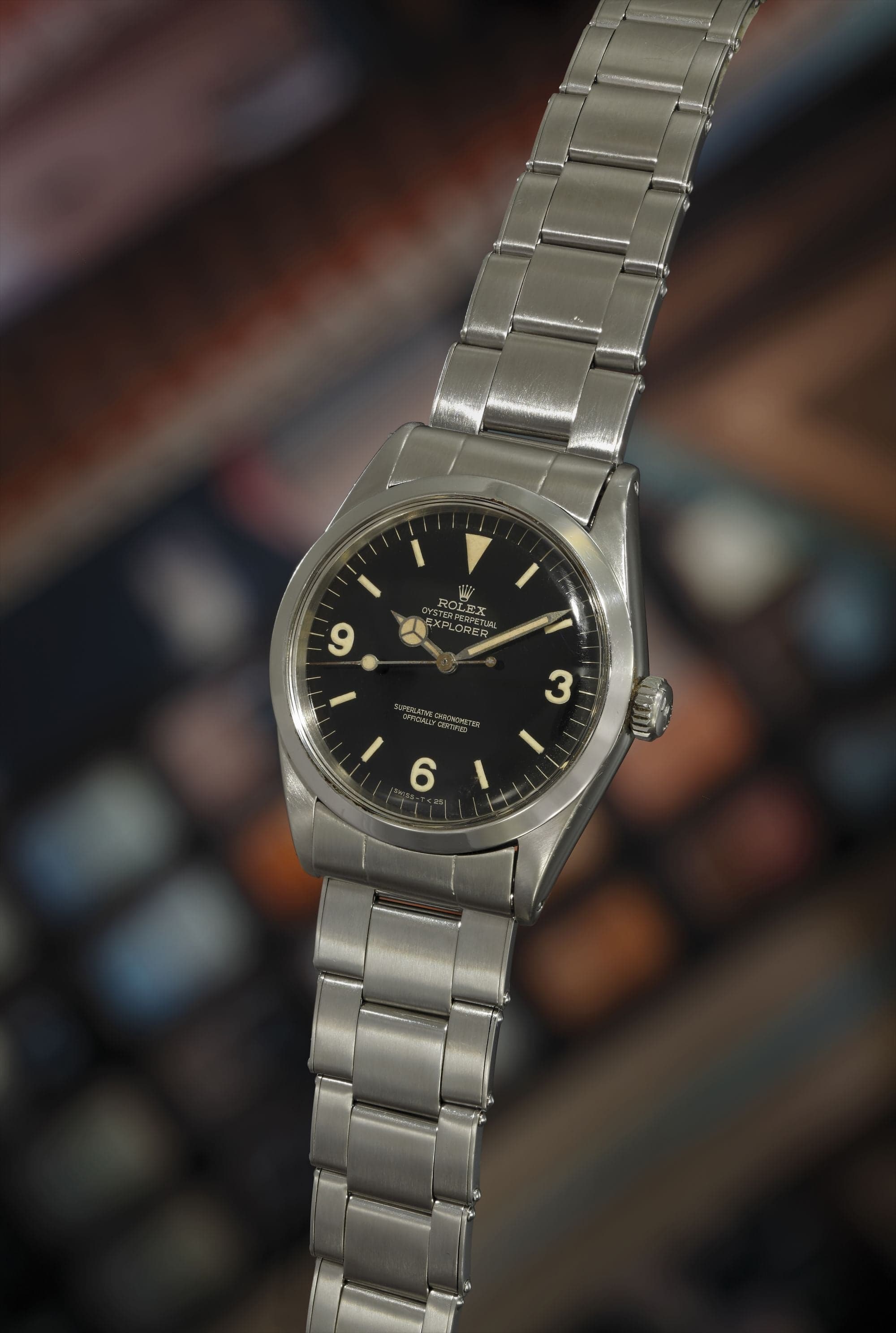
 Photo: Phillips Auctioneers
 What should I know before buying a vintage Rolex?
Five things matter most: (1) Reference numbers — every Rolex reference encodes specific information about generation, case material, and complications. (2) Dial originality — vintage Rolex dials degrade with age, and "service dials" replace original dials during factory service, reducing value 30–60%. (3) Movement matching — confirm the movement number matches the case serial through Rolex archives; mismatches indicate "frankenwatches." (4) Papers and provenance — original warranty card, box, and service history add 20–50% to value. (5) Condition vs originality — heavy polishing reduces collector value even when it improves apparent condition. Authentication is more important than price.
What makes vintage Rolex unique
Vintage Rolex is the most-collected vintage watch market in horology, and the market exists because Rolex's production has a specific structural property: the company has been making essentially the same watches for 60+ years. The 1953 Submariner and the 2026 Submariner share visual DNA, case architecture, and movement design philosophy — but evolved through dozens of reference numbers across that span. Every reference change introduced new variations: dial finishes, bezel inserts, case dimensions, lume compositions, movement calibers. Each variation creates a collector-recognized reference.
The result is a vintage market with extraordinary depth: hundreds of collectible references across the Submariner, GMT-Master, Daytona, Datejust, Day-Date, Sea-Dweller, Explorer, and Air-King families, each with multiple variants and dial types. The market also has extraordinary depth of authentication infrastructure: auction houses (Phillips Watches in particular has built specialist vintage-Rolex departments), established dealers (Bob's Watches Vintage, Watch Geek, La Connoisseur), reference photography (the Hodinkee Reference Points archive, Phillips catalog photography, Christie's vintage Rolex catalogs from 30+ years of auctions), and books (the Mondani Rolex Encyclopedia, the Manuali books, the John Goldberger Submariner book).
The structural advantage of this depth is also the structural risk. Vintage Rolex has the most-developed faking, redialling, and frankenwatch industry in horology. The economic incentive — a vintage Submariner 5513 with original gilt dial trades for $40,000–$80,000 vs $5,000–$15,000 for a tired example — drives substantial fraud at every level of the market. Every serious vintage Rolex buyer learns authentication or pays the "tuition fee" of buying a fake or frankenwatch on the way to learning.
The vintage Rolex market is the most-collected, most-developed, and most-faked vintage watch market in horology. Authentication isn't optional. The watches that command real money are verified; the watches that don't are tuition.
Subdial Editors
Reading reference numbers
Rolex reference numbers encode generation, complications, and case material. The leading digit roughly indicates the era: 6xxx = 1950s, 5xxx = 1960s through early 1970s, 1xxxx = late 1970s through early 2000s, 11xxxx = 2000s through 2020, 12xxxx = current. Subsequent digits indicate family and features. The full taxonomy across the major families:
Submariner family
- 6204, 6205, 6536, 6538 — 1953–1958 (the founding era). 6538 is the "Big Crown" Bond Submariner with 8mm crown for diving-glove use, worn by Sean Connery in Dr. No (1962). Auction range: $80,000–$300,000+.
- 5512, 5513 — 1959–1989. 5512 is chronometer-certified (4-line dial); 5513 is the mass-production version (2-line dial). 5513 ran for 27 years — the longest-running Submariner reference. Auction range: $20,000–$150,000+ depending on dial condition.
- 1680 — 1969–1979. First Submariner with date complication. "Red Sub" 1680 has red "Submariner" text on the dial (1969–1973); "White Sub" has white text (1973–1979). Red Sub auction range: $25,000–$80,000+.
- 16800 — 1979–1989. First Submariner with sapphire crystal. 300m water resistance. Bridges vintage and modern era.
- 16610 — 1988–2010. Modern Submariner Date with aluminum bezel. The reference most collectors call "modern vintage."
- 116610 — 2010–2020. Cerachrom ceramic bezel introduced. "Maxi case" redesign with broader lugs.
- 124060 / 126610 — 2020–present. Current 41mm production with Caliber 3230 (no date) and 3235 (date).
GMT-Master family
- 6542 — 1955–1959. Original GMT-Master designed for Pan Am pilots. Bakelite bezel inserts. Multi-year auction range: $40,000–$150,000+.
- 1675 — 1959–1980. The classic GMT-Master. Aluminum bezel insert, available in "Pepsi" (red/blue), "Coke" (red/black), and "Coke and Pepsi" combinations. Most-collected vintage GMT reference.
- 16750 — 1980–1988. Bridge reference between vintage and modern. Quickset date.
- 16710 — 1989–2007. The last aluminum-bezel GMT-Master II. Available in "Pepsi," "Coke," and "Black" (called "BLNR" though that designation is post-2007).
- 116710 — 2007–2018. First Cerachrom ceramic bezel GMT.
- 126710BLRO / 126710BLNR / 126720VTNR — 2018–present. Current GMT-Master II references.
Daytona family
- 6239 / 6241 / 6262 / 6263 / 6264 / 6265 — 1963–1988. Vintage manual-wind Daytona references. The "Paul Newman dial" variants (different sub-dial design with squared-off marker fonts and exotic dial colors) are the most-collected vintage Rolex by price. 6239 with Paul Newman dial: $250,000–$1,000,000+.
- 16520 / 16523 / 16528 — 1988–2000. "Zenith Daytona" — used the Zenith El Primero base movement modified by Rolex. The only Daytona with a non-Rolex movement.
- 116520 / 116523 / 116528 — 2000–2016. First in-house Daytona movement (Caliber 4130). Discontinued in 2016 in favor of Cerachrom.
- 116500LN / 126500LN — 2016–present. Current Daytona with Cerachrom bezel.
Datejust and Day-Date
Datejust references span 6605 (1957) → 1601 (1959–1977) → 16014 (1977–1988) → 16234 (1988–2010) → 116234 (2010–2020) → 126234 (2020–present). Day-Date references span 6611 (1956) → 1803 (1959–1977) → 18038 (1977–1988) → 18238 (1988–1995) → 118238 (1995–2008) → 218238 (2008–2015) → 228238 (2015–present). Both families have hundreds of dial-and-bezel variants across their history; vintage value depends heavily on dial originality and metal type.
Dial originality
Gilt vs matte
Pre-1968 Rolex sport watches used "gilt" dials — black dials with gold-tone printing produced via galvanic plating, depositing gold onto the black dial through a chemical process. Post-1968 Rolex switched to matte dials with white printing for cost reasons. Gilt dials are generally more valuable than matte for vintage collectors. A 1962 Submariner 5513 with original gilt dial sells at $40,000–$80,000; the same watch with original matte dial sells at $25,000–$45,000. The gilt-vs-matte transition (1967–1968) is the most important pricing inflection point in vintage Rolex.
Tropical dials
A "tropical" dial is a vintage dial that has aged from black to warm brown due to UV exposure and chemical changes in the dial paint. Particularly prized on Submariner 5513, GMT-Master 1675, and Daytona 6263 references. Original tropical examples can sell at 3–5× equivalent non-tropical examples in the same reference. The aesthetic is divisive — some collectors prefer the warm patina, others find it inconsistent — but collector demand is durable. Authentication matters because tropical aging can be artificially induced (UV chambers, chemical exposure) or faked. Verified-original tropical examples come with auction-house authentication or established-dealer documentation.
Service dials
When Rolex services a vintage watch and the original dial is damaged or faded beyond repair, Rolex's historical practice was to replace the original dial with a current-production "service dial" matching the original specification visually. Service dials reduce vintage value 30–60% compared to equivalent original-dial examples. Identifying service dials requires expertise — subtle differences in printing weight, lume composition, font kerning, and metallic tones distinguish original from replacement. The "Service Dial" stamp on the back of replacement dials (when present) is the most reliable indicator. Modern Rolex service policy has shifted somewhat — they now offer original-dial preservation for verified collector pieces — but decades of service-dial replacements are present in the market.
Lume composition aging
Vintage Rolex used three distinct lume compositions across its production history, each with characteristic aging patterns:
- Radium (pre-1962). Mildly radioactive paint. Ages to deep yellow or pumpkin orange over decades. Modern detection uses a Geiger counter — radium is still actively decaying and produces measurable radiation. Original radium dials are illegal to ship internationally in some jurisdictions; check before purchase.
- Tritium (1962–1998). The phrase "T SWISS T" or "SWISS — T < 25" on the dial indicates tritium. Ages from cream-colored to brown over decades. The most-prized vintage Rolex lume — aged tritium with even patina across the dial is a major value driver.
- Super-LumiNova / LumiNova (1998–2008) and Chromalight (Rolex proprietary, 2008–present). Modern synthetic lume that doesn't age the same way. Service dials with Super-LumiNova replacing original tritium are visually obvious to experienced eyes — the lume tone is wrong for the period.
Movement and case matching
Every Rolex case has a serial number engraved between the lugs at the 6 o'clock position; every movement has a separate movement number stamped on the movement plate. Rolex archives these pairings at production. A "matching numbers" watch has its original case and movement together from the production line. A "frankenwatch" has movement and case from different watches, assembled to look like a single complete reference.
Several authentication pathways verify case-movement matching:
- Original Rolex papers. The "Punch Card" warranty paper records both serial numbers. A watch with original papers proves matching at the time of original sale. Be wary of papers that don't match the watch — they may be authentic papers from a different watch.
- Rolex archive verification. Rolex Service Centers can verify case-movement matching through their archive lookup service for a fee (typically $300–500 in the United States). For high-value vintage pieces, this is the gold standard of authentication.
- Auction-house authentication. Phillips, Christie's, and Sotheby's perform case-movement matching as part of their pre-auction authentication process. Watches sold at major auctions come with this authentication implicitly.
- Established-dealer authentication. Bob's Watches, Watch Geek, and other established vintage Rolex dealers perform their own authentication and offer warranties backed by that authentication.
Common frankenwatch indicators
Frankenwatches are particularly common in vintage Daytona, Submariner, and GMT-Master markets where part values exceed whole-watch values. Six indicators that should trigger close inspection:
- Inconsistent aging across components. Original parts age together; frankenwatch parts age separately. Lume, dial, hands, and bezel insert that age at different rates suggest assembly from multiple watches.
- Mismatched lume between dial and hands. Original Rolex hands and dials use the same lume composition from the factory. Hands with modern Super-LumiNova on a dial with original tritium is a major red flag.
- Period-incorrect movement. Specific reference-movement pairings. A 1960s 5513 case with a 1970s 1520 movement (which would have been service-replaced) suggests the watch has been through major service or is a frankenwatch.
- Anomalous bezel inserts. Reference-correct bezel inserts have specific font, color, and material specifications. Modern aftermarket bezel inserts are common on franken-watches.
- Aged bracelet and case mismatch. Brushed-and-polished cases with mint-condition bracelets, or vice versa, suggest one component has been replaced.
- Paperwork that doesn't match. Original papers with serial numbers different from the case, or papers from a different period than the watch claims to be, are immediate disqualifications.
Price ranges by reference (representative 2025–2026)
Pricing varies substantially by condition, originality, and market conditions. Representative ranges for original-dial, matching-numbers, honest-condition examples:
- Submariner 6538 Bond — $80,000–$300,000+
- Submariner 5513 (gilt era, 1962–1967) — $40,000–$120,000+
- Submariner 5513 (matte, 1968–1989) — $20,000–$45,000
- Submariner 1680 Red Sub (1969–1973) — $25,000–$80,000+
- Submariner 1680 White Sub (1973–1979) — $15,000–$30,000
- GMT-Master 1675 Pepsi (matte dial era) — $20,000–$60,000+
- Daytona 6239 with Paul Newman dial — $250,000–$1,000,000+
- Daytona 6263 Big Red — $100,000–$300,000+
- Daytona 16520 Zenith — $20,000–$50,000
- Datejust 1601 (1959–1977) — $4,000–$15,000
- Day-Date 1803 (1959–1977) — $8,000–$25,000+ depending on metal
- Explorer 1016 (1963–1989) — $20,000–$60,000+
Vintage Rolex service considerations
Service philosophy on vintage Rolex differs sharply from modern service. Modern Rolex service follows a standardized protocol — full disassembly, ultrasonic cleaning, parts replacement to current specification. For modern watches, this is entirely correct. For vintage watches, the same protocol destroys collector value: original tritium lume is replaced with Super-LumiNova, original dials are replaced with service dials, original hands are replaced with modern equivalents, and original case profiles are polished to remove honest wear.
Serious vintage collectors avoid Rolex Service Centers for vintage pieces and use independent vintage specialists instead. The recommended specialists: Vintage Time Mart (New York), La Connoisseur (Geneva), Robert at Watch Geek, Bernard Roobaert's atelier (Belgium), Watch Repair NYC, and others. These specialists service vintage Rolex movements without replacing original cosmetic components. Service cost is comparable ($600–1,200 for a typical service) but the watch returns with its original character intact.
Books and resources for serious collectors
The vintage Rolex collector community has produced a substantial body of reference literature. Essential books:
- Mondani Rolex Encyclopedia (Guido Mondani Editions, multiple volumes) — the encyclopedic reference for vintage Rolex production. Most-comprehensive reference numbers, dial variants, and production years.
- Vintage Rolex: The Largest Collection in the World (David Silver) — visual reference photography of every major vintage Rolex reference.
- Rolex Submariner (John Goldberger) — the canonical reference on Submariner production.
- The Best of Time: Rolex Wristwatches (Jeffrey P. Hess and James Dowling) — historical reference covering all major Rolex sport watches.
- The Best of Time (Robert P. Hess) — companion volume on dressy and complicated Rolex.
Online resources:
- Hodinkee Reference Points archive — extensive feature articles on specific vintage Rolex references with verified-original reference photography.
- Phillips Watches catalog archive — auction catalogs with detailed photography and descriptions of every vintage Rolex sold at Phillips since 2015.
- Christie's Watches catalog archive — same, for Christie's vintage Rolex auctions.
- Rolex Forums (rolexforums.com) — the largest vintage Rolex enthusiast community, with deep reference threads on every major collectible.
- Watch Charts vintage Rolex price tracker — current secondary-market pricing for vintage Rolex references.
Where to buy
Established dealers with authentication and warranty: Watches of Switzerland Pre-Owned, Bob's Watches Vintage, WatchBox, Hodinkee Shop pre-owned, Watch Geek, La Connoisseur, Phillips (auction), Christie's (auction), Sotheby's (auction), Antiquorum (auction), Wempe Pre-Owned. Avoid eBay listings without significant dealer reputation, Chrono24 listings without verified dealer credentials, and any seller who can't produce service history or cannot answer detailed questions about reference, year, and movement number. The vintage Rolex market is full of fakes and frankenwatches; authentication matters more than price.
Read next
For deeper coverage of Rolex generally:
For other vintage references and authentication primers:
- Vintage Omega — Pre-Apollo Speedmasters and Original Constellations
- Vintage Heuer — Pre-TAG Carrera, Monaco, Autavia
- Authentication 101 — Universal Vintage Watch Verification
- Vintage Watches — The Hub
For cross-context on where vintage Rolex sits in the modern market: